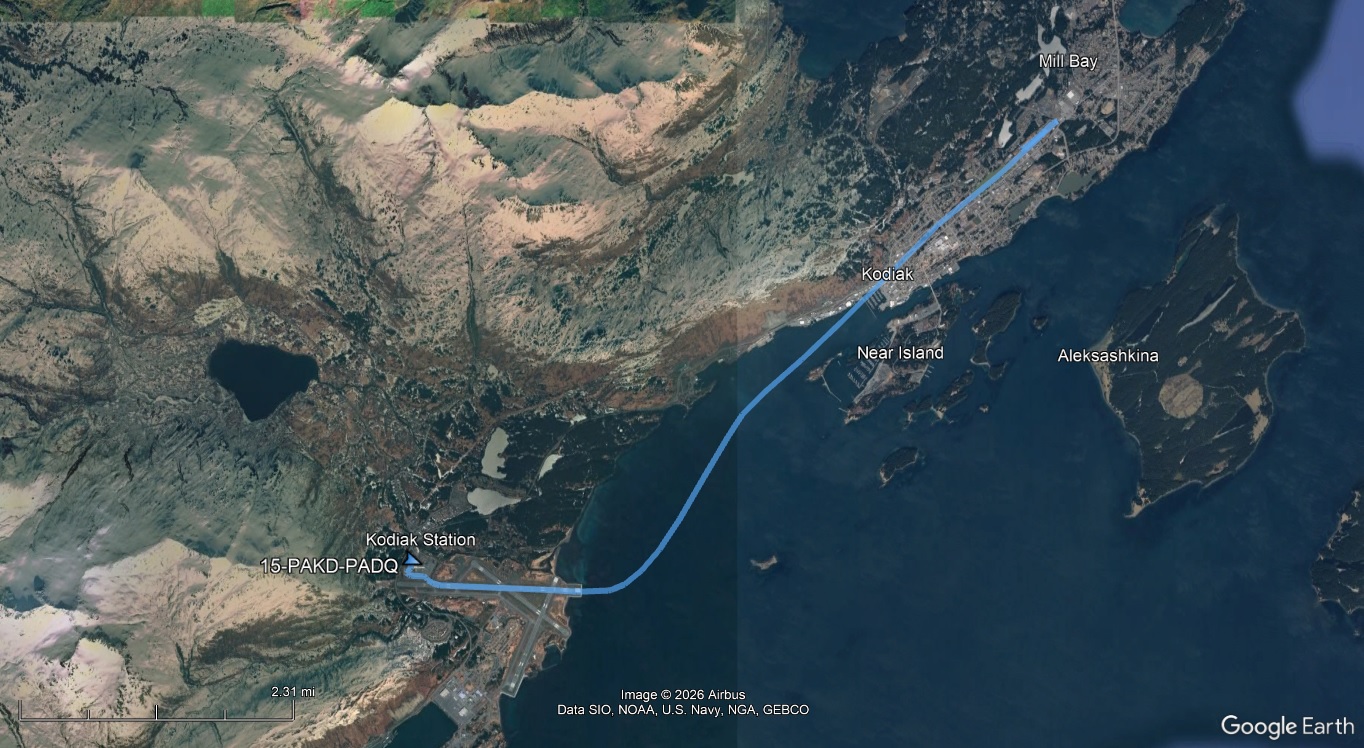
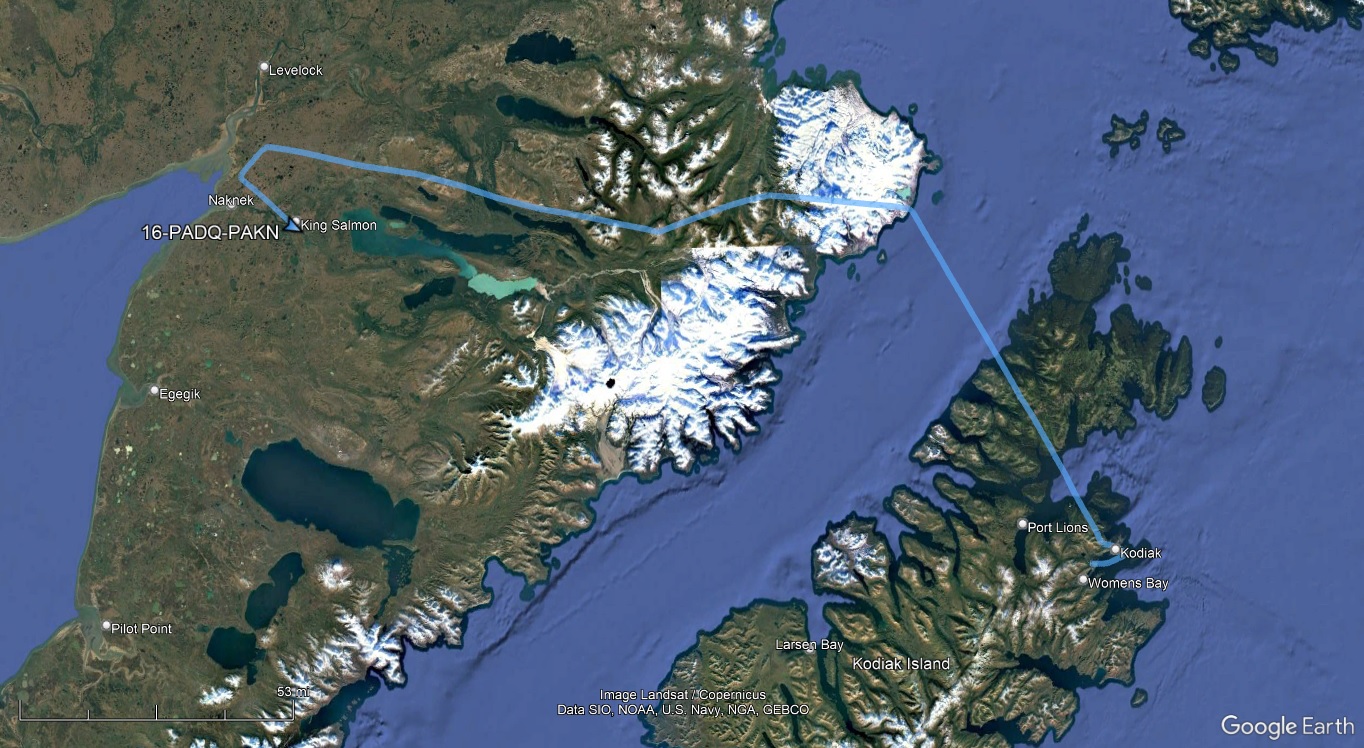
While I avoided the steep overnight parking fees at Kodiak State Airport, I did need to stop there for some expensive fuel before heading back to King Salmon. ($12.50/gal, which was topped later in the trip by $13/gal at Valdez)
I made the short hop through light rain and low but VFR ceilings, then picked up my IFR clearance (ODK T368 AKN) to King Salmon after fueling.
There was a 23nm segment on the route that had an MEA of 9200' which would have me in forecast possible icing conditions. I figured it was a relatively short segment and there was good chance I'd be above the clouds. Also, I'd have to climb early to meet minimum crossing restrictions on the way to the segment, so if I did encounter icing I could descend and return to Kodiak if needed.
Things went about as planned - I was cleared to 12000', found myself on top of the deck, and OAT was only just getting to freezing there. It got a little more interesting as I approached that high MEA flight segment. First, Anchorage Center advised that radio coverage would be lost soon and I should call the next frequency in 15 minutes. Then I found myself entering a bank of clouds. After a while, I could see a dusting of frost forming on the leading edges of the wing and at the base of the windscreen. It was accumulating slowly, and I'd be back in contact with ATC in a few minutes, so I elected to just watch it as opposed to make any immediate changes. I had 2800' below me to the MEA, and in a few miles, that would grow to 5000'. At the somewhat ironically named WORRI reporting point, I got in touch with Anchorage Center, reported the icing, and requested lower. I got a descent down to 8000', which appeared to stop the accretion, but the ice I was already carrying stayed with me until I got lower on the approach to King Salmon.
King Salmon itself was reporting 4700' overcast, though there were a few lower clouds along the approach path. While I requested and was set up for the RNAV 12 approach, it was essentially a visual approach.
King Salmon Airport was built as the World War II era Naknek Air Force Base and transitioned to civilian use after the closure of the base in the 1990's. Its size, and with King Salmon being the tourism hub for the Katmai region, gave me the mistaken impression the town was much bigger than it was. In fact, the town hosts a resident population of slightly more than 300. From the door of the Alaska Airlines terminal, it's less than a 1000 foot walk to anything useful in town - motel, restaurant, market, visitor center, car rental.
The GA ramp is across the airport from the main terminal, so it's a less walkable (with luggage) 1.6 miles into town. Perhaps because they didn't want to be in the taxi business, the car rental outfit charged $75 for an airport pickup (on top of the $300/day rental). I hitched a ride to pick up my rental car instead.
While it was nice to be able to get around and explore the area with the car, if I'm ever back in King Salmon again, I'll probably skip the expense. What there is to see isn't worth the cost, especially the second time around. It did let me get over to the public Thursday steak night at the King Salmon Lodge (which other days serves guests only) for a much better meal than at the saloon in town.
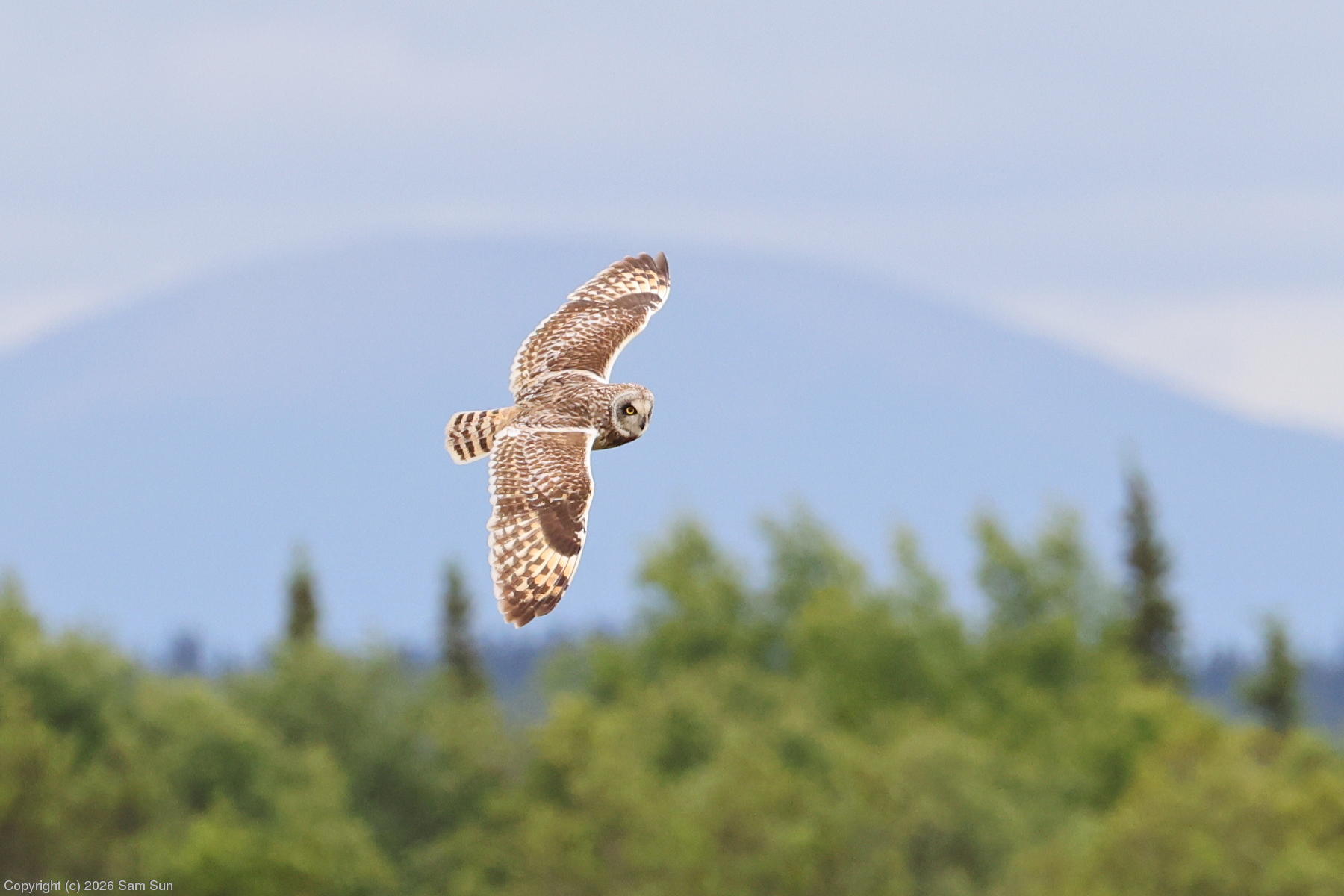
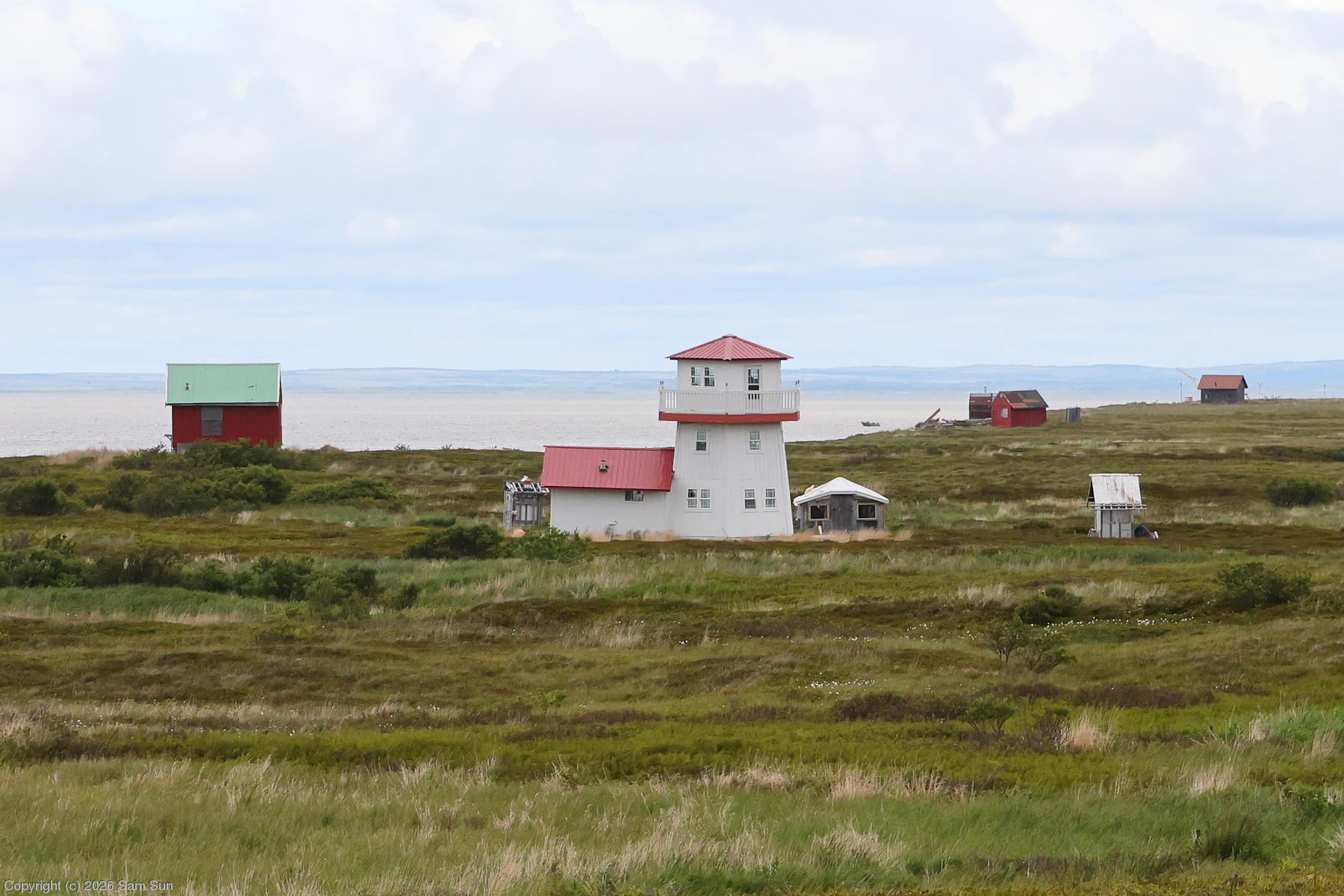
One of my friends arrived on the midday flight from Anchorage and we drove the 15 or so miles out to the beach at Naknek. Our most interesting sighting of the day was a Short-eared Owl hunting over the fields just outside King Salmon Airport.
| Short-eared Owl |
 |
| Unique house in Naknek |
 |
Brooks Falls, and the associated lodge and campground, is accessible via floatplane from King Salmon. Numerous tour operators offer day trips from Anchorage, although weather, timing, and crowds can make the day trips from there a dicey proposition. During peak season, wait times for the viewing platform can be more than an hour, and you're limited to 30 minutes at a time on the platform. There are stories of visitors who encountered weather delays on the flight out who never got to the main viewing platform before they had to head back.
During my stay at King Salmon Lodge the previous week, I met a group touring with Natural Habitat Adventures, an eco-tour operator I've previously traveled with. They structure their Brooks Falls visits around day trips out of King Salmon, which cuts out a few hours of travel each day and allows more time at Brooks. The tour includes 3 day trips into the park, returning each night to King Salmon. Altogether not a bad strategy, and something I might try if I go back to Brooks Falls without another lottery win.
The benefit of being on site at the lodge or campground is that you can visit the viewing platforms at your leisure in the morning or evening when the day trip visitors aren't around, when there are no time limits on the platforms.
Brooks Lodge Arrival
After meeting a couple more friends at the airport, we all took the shuttle down to the Katmai Air floatplane base. The flight to Brooks Camp was on a turbine Otter on floats. The plane has 900 HP and seats 10, but only cruises at 116 knots. It hauls a lot, but is not meant to be fast. Ceilings were good and we made the trip at 1500'.
It was a short flight to Brooks Camp, and true to its reputation for bears, we saw some on the beach before even getting out of the plane. Upon arrival, the first order of business for visitors is bear school, a roughly 30 minute session with a ranger and video program on how to be as uninteresting to bears as possible: No food except in designated areas. All possessions within reach or on your person at all times. DO NOT RUN. Basically, give no reason for the bears to think of people as a potential source of food or toys.
On the way to lodge checkin, we were greeted by more bears passing through the grounds. After setting down in our cabin and having dinner, we walked out to the viewing platforms on the river.
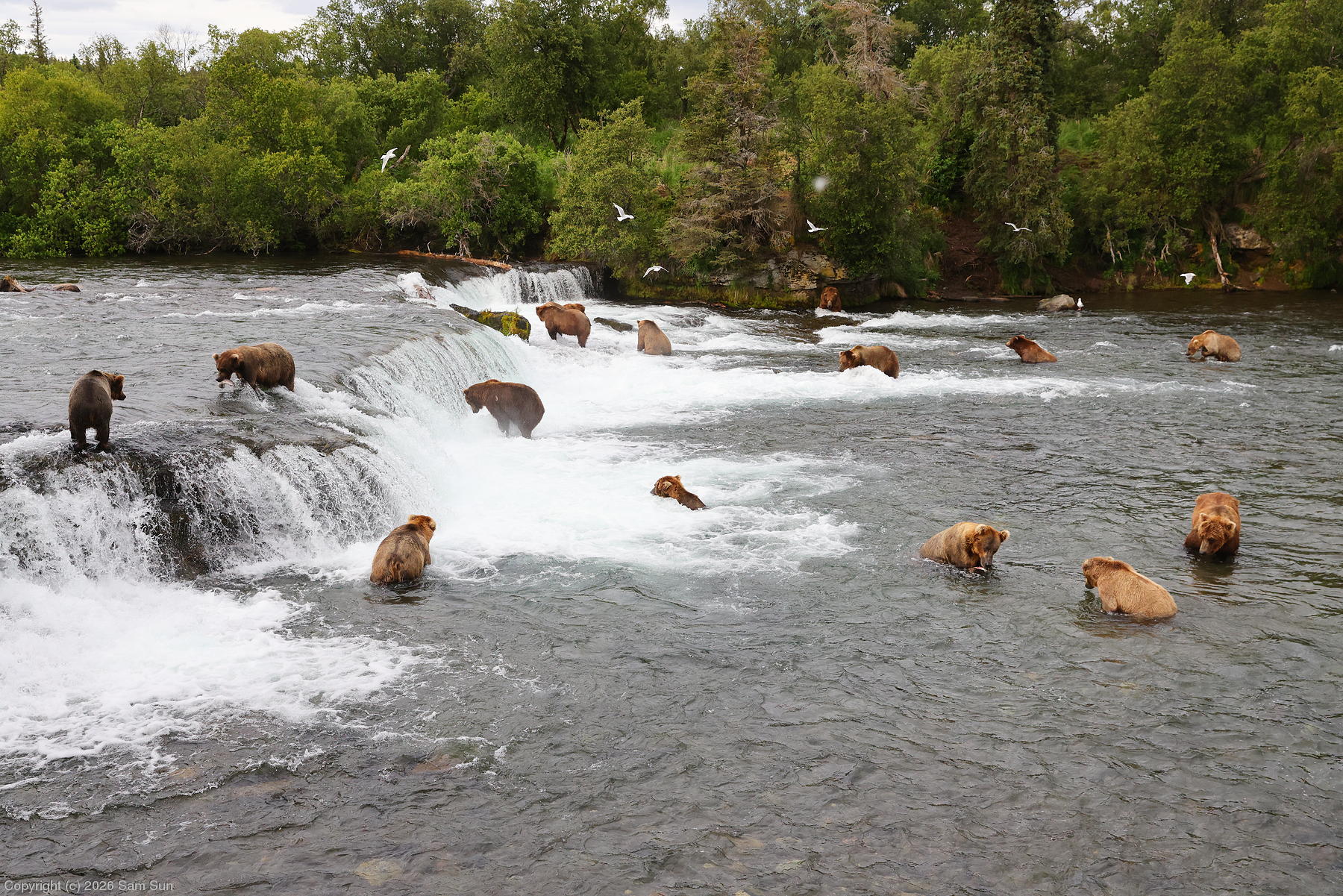
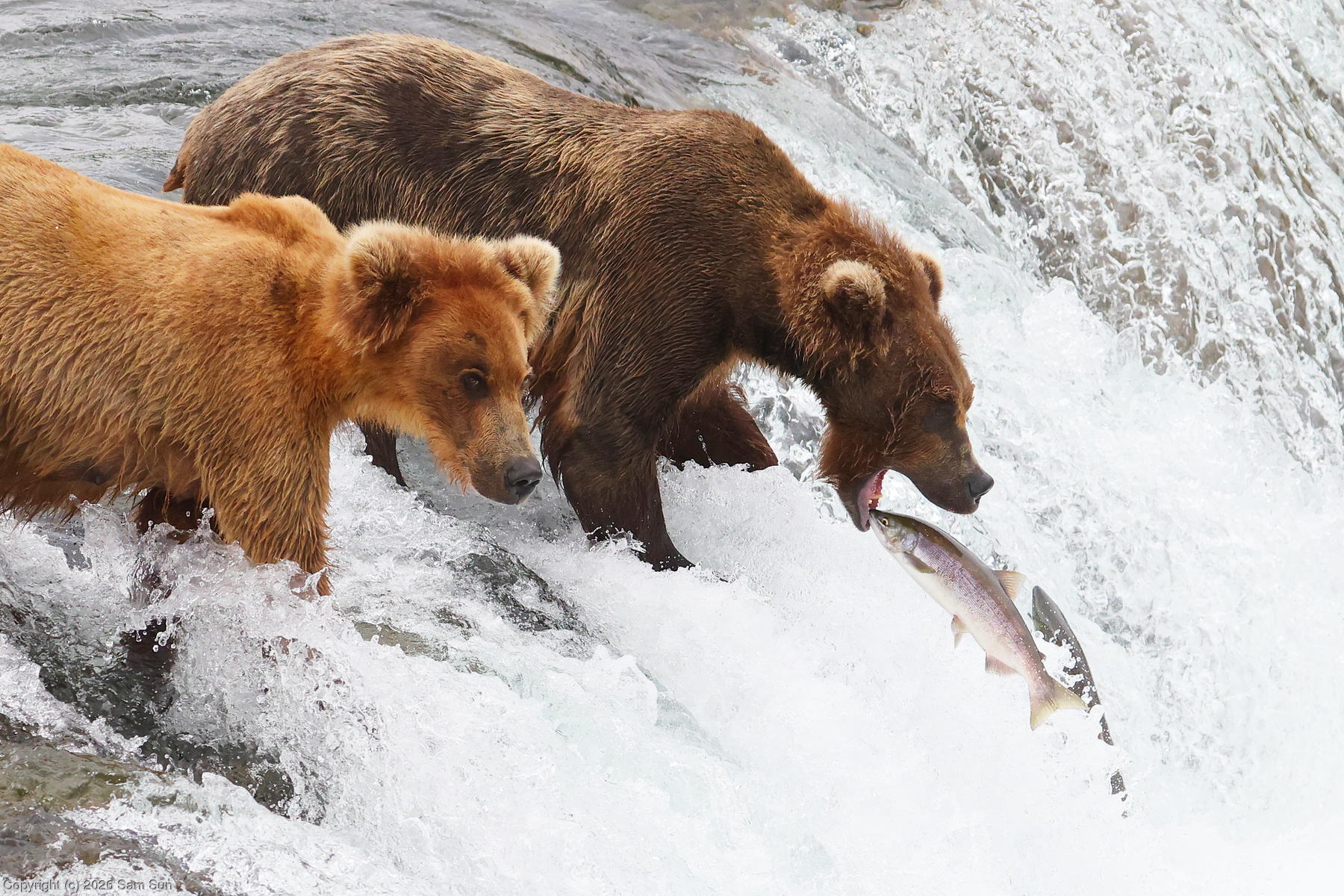
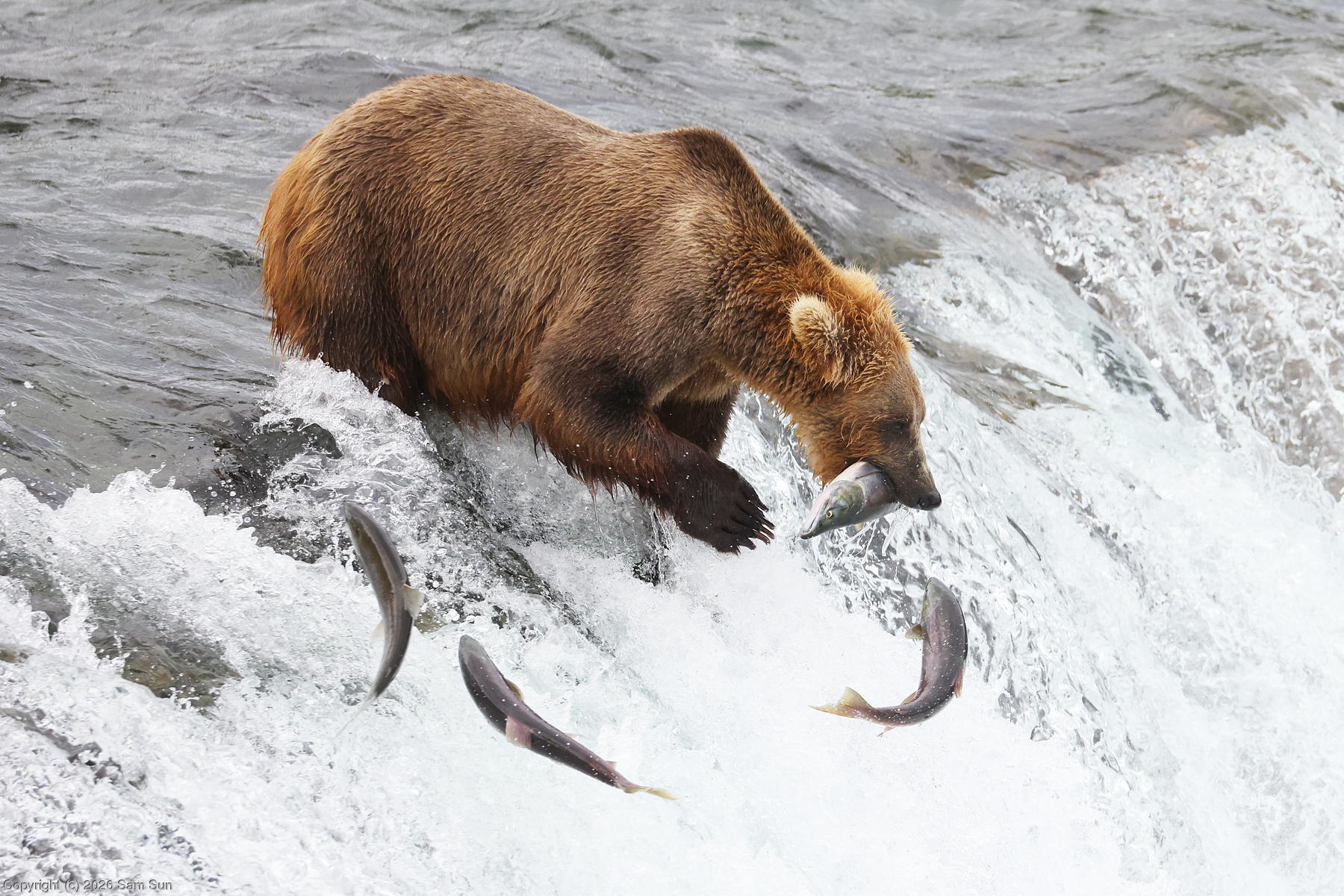
The Brooks Falls viewing platform did not disappoint. It was the BearCam, but now in person! (The BearCam itself is mounted in a small housing beneath one corner of the platform.) More than a dozen bears were congregated around the falls fishing. One would occasionally walk by perhaps 10 feet below the elevated platform. After watching for a while, their individual quirks and fishing styles became apparent. One at the lip of the falls would periodically toss its head to its left for no apparent reason. Another would perch on a rock and leap into the river after a fish. In the pool dubbed "The Jacuzzi" at the base of the falls, one would sit passively and just pin hapless fish against its side. Also visible was a behavior dubbed "high-grading" where a bear would eat only the most calorie-dense skin, brains, and roe, and discard the meaty part of the fish for the scavengers downstream. With plenty of fish around, it's essentially too much effort to eat and digest the rest of the fish.
| The classic Brooks Falls view |
 |
| Fishing from the top of the falls |
 |
Brooks Lodge Day 2
We took a guided river walk in the morning. Donning waders, we made our way upstream along the bank of the river, making a couple crossings. The main draw of the river walk is being at eye level with the bears. We saw quite a few while hiking/wading up the river, but the falls were deserted for some reason that morning.
After lunch, I took a peaceful walk out to Brooks Lake. Although there is a picnic area and other facilities there, apparently not many visitors (or bears) tend to go out there.
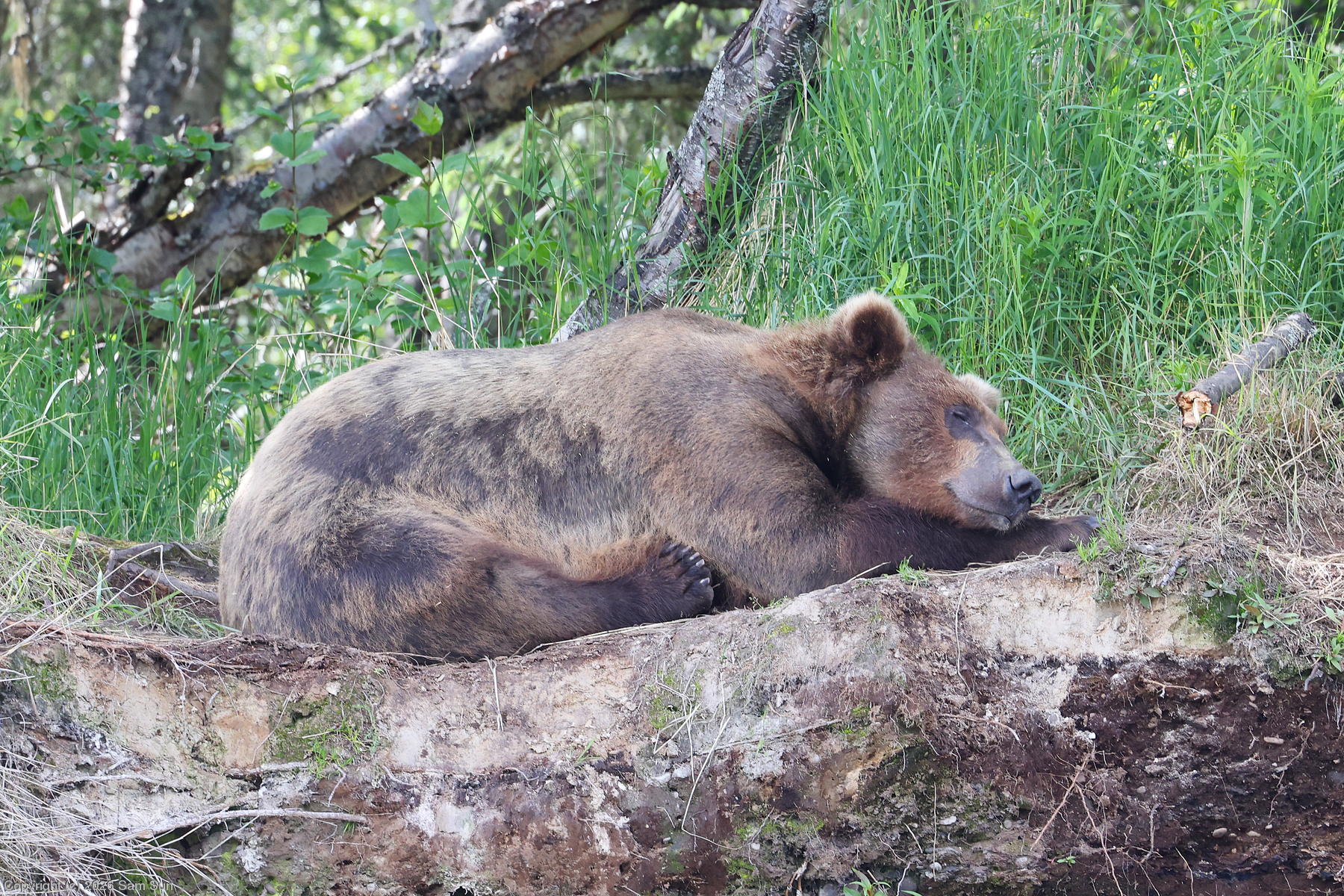
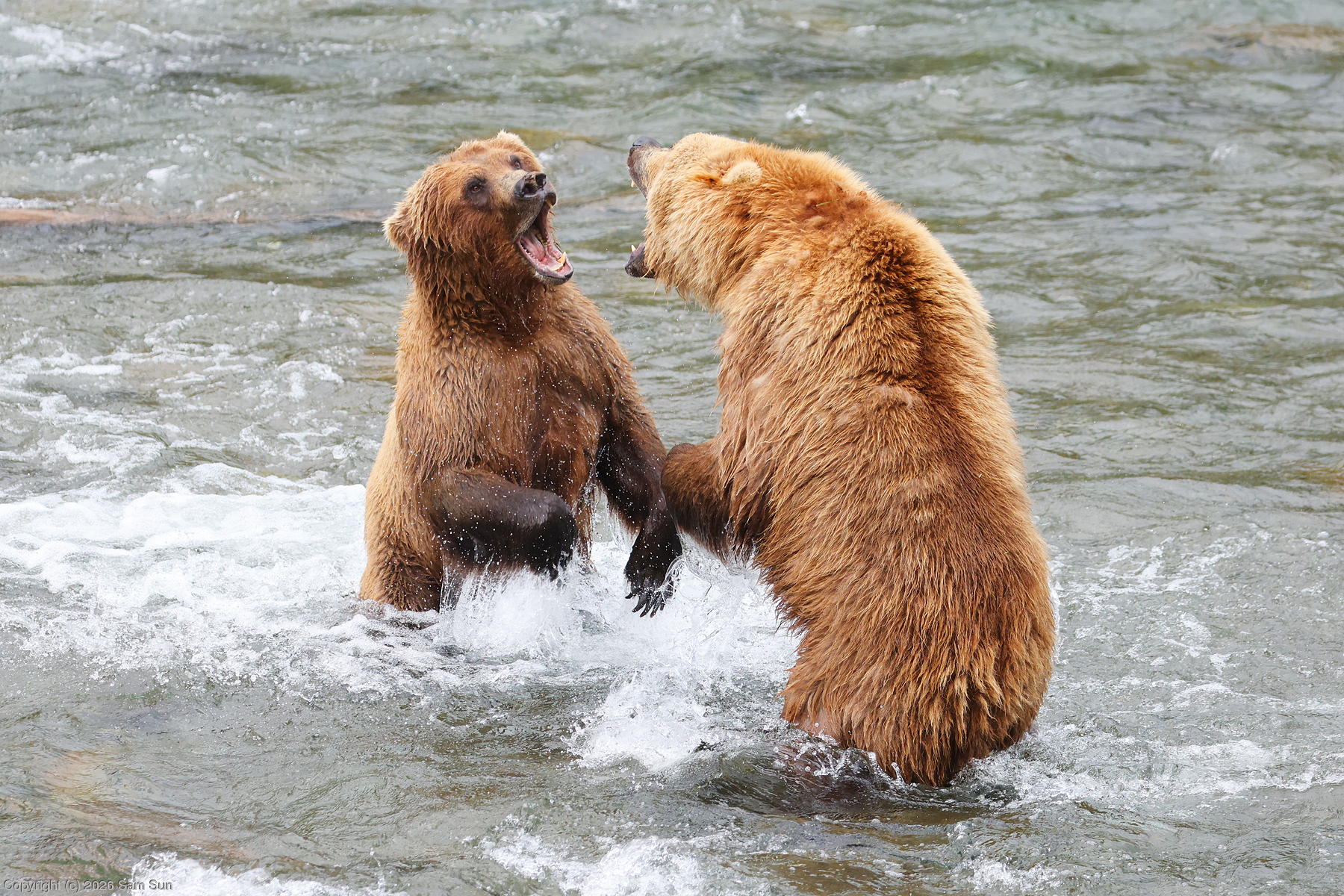
After dinner, it was back to the falls after most of the day-trippers left. The bears had returned during the afternoon, but there seemed to be fewer fish than the day before, and as a result the bears seemed more grumpy, and there were more altercations and growling amongst them.
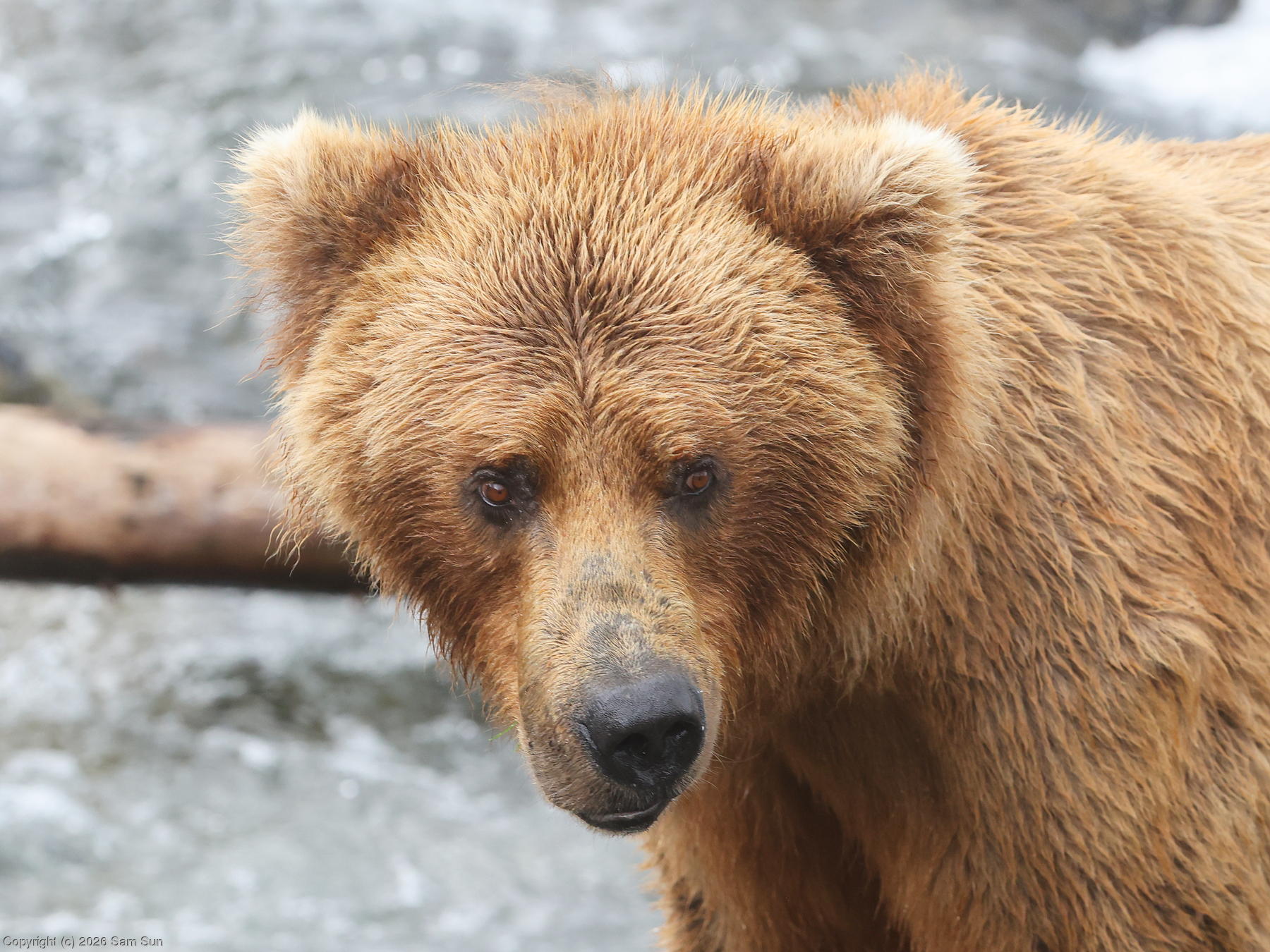
| Up close and personal |
 |
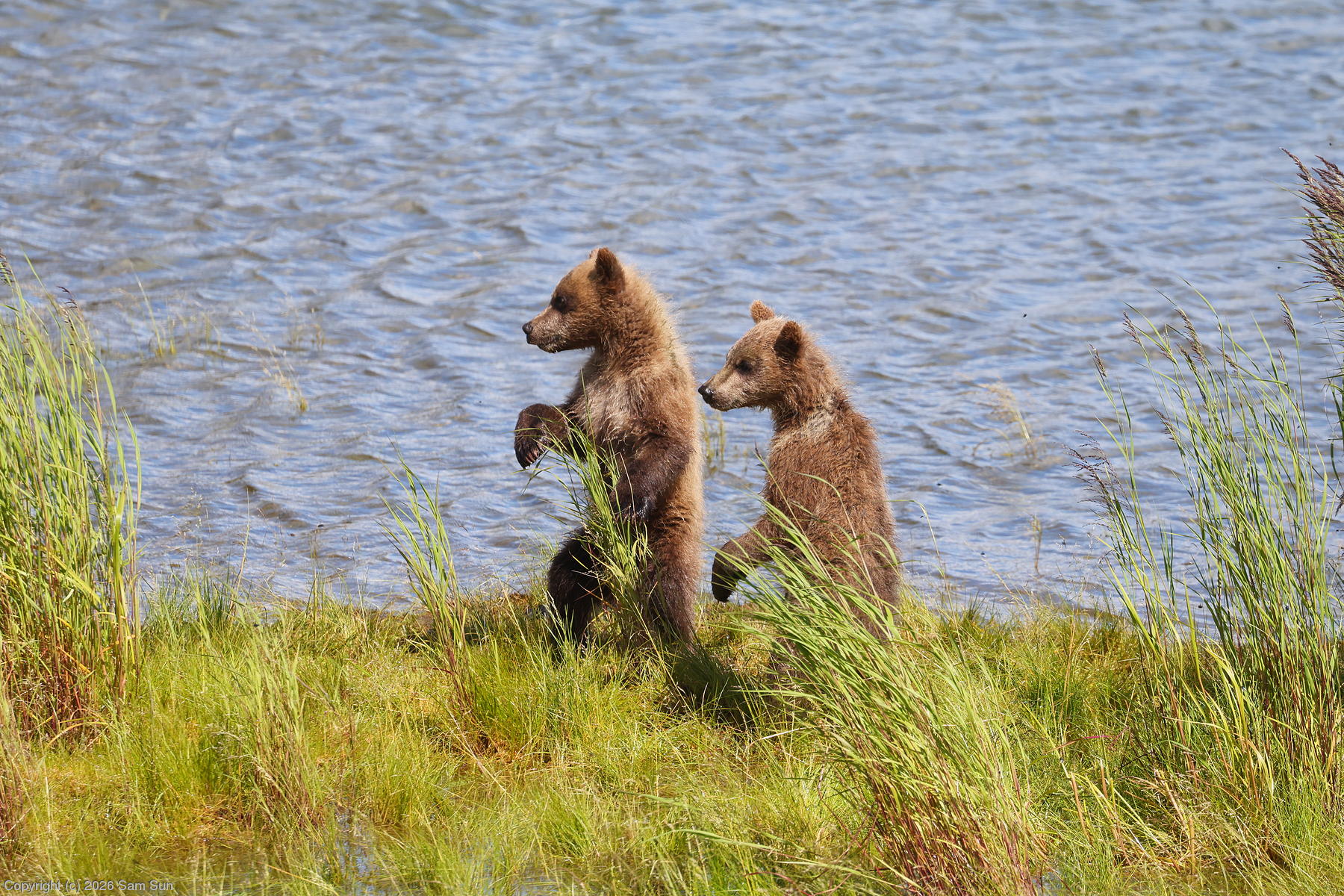
| Cubs keeping track of mom |
 |
| A content bear |
 |
| A confrontation |
 |
Brooks Lodge Day 3
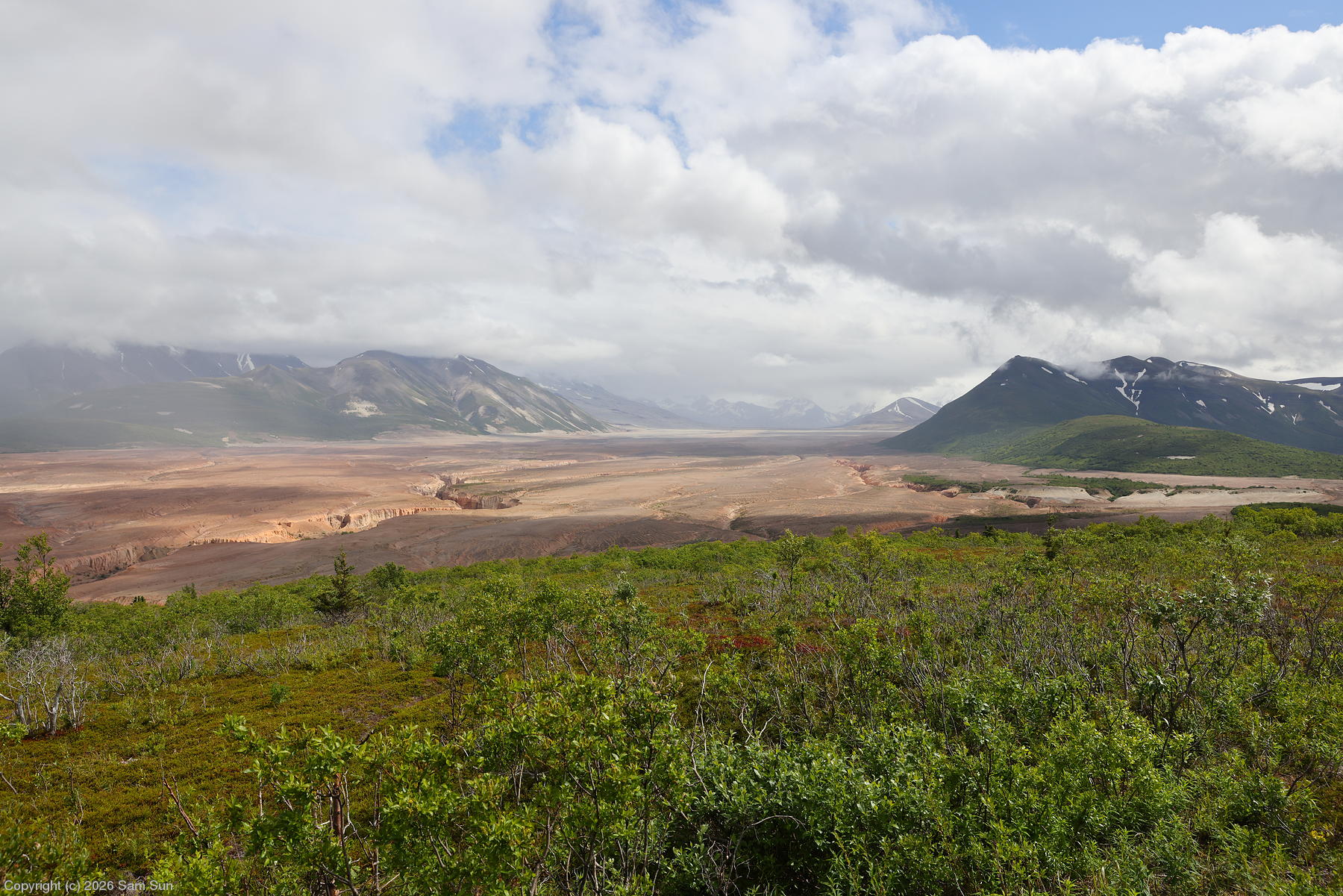
We took the day trip bus tour to the Valley of Ten Thousand Smokes. Formed by the 1912 Novarupta eruption - 30 times larger than Mt. St. Helens' 1980 eruption! - volcanic ash blankets the valley to a depth of 700 feet. Erosion from the River Lethe and Knife Creek have cut deep canyons into the soft ash. The tour included a ranger-led hike down to Ukak Falls where the eroded ash formations were reminiscent of the canyons of Utah.
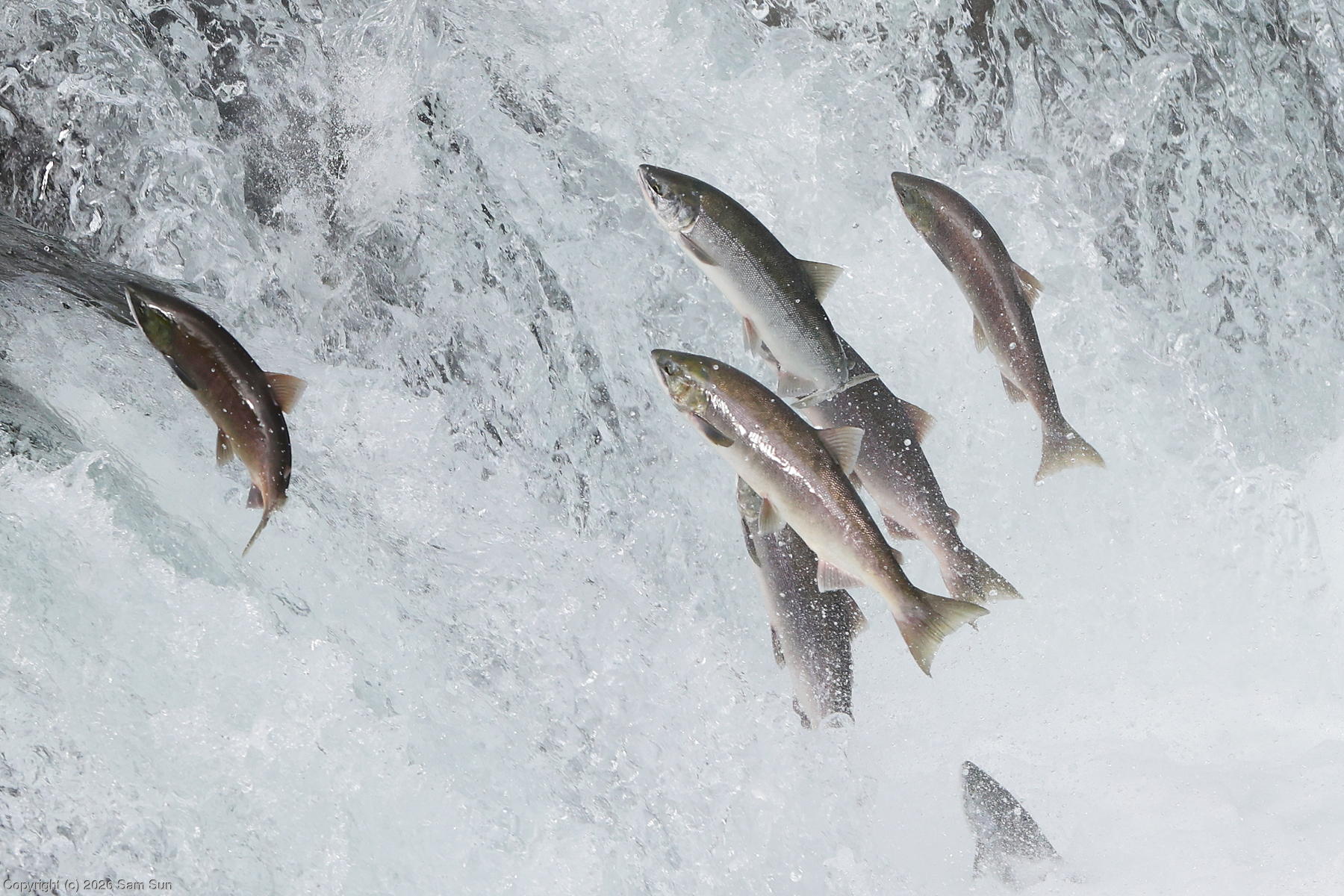
Back at the falls after dinner, the salmon were popping like popcorn! There was some speculation that the salmon fishing season had ended a few days before, so a new influx of fish were getting through. In any case, there were fewer bears around than the day before, presumably because many of them had gotten their fill during the day. Did I mention the salmon were going completely bonkers? At times more than a dozen fish at a time could be seen jumping the falls!
All in all, Brooks Falls lived up to its reputation, and was absolutely worth all the efforts to get there.
| Valley of Ten Thousand Smokes |
 |
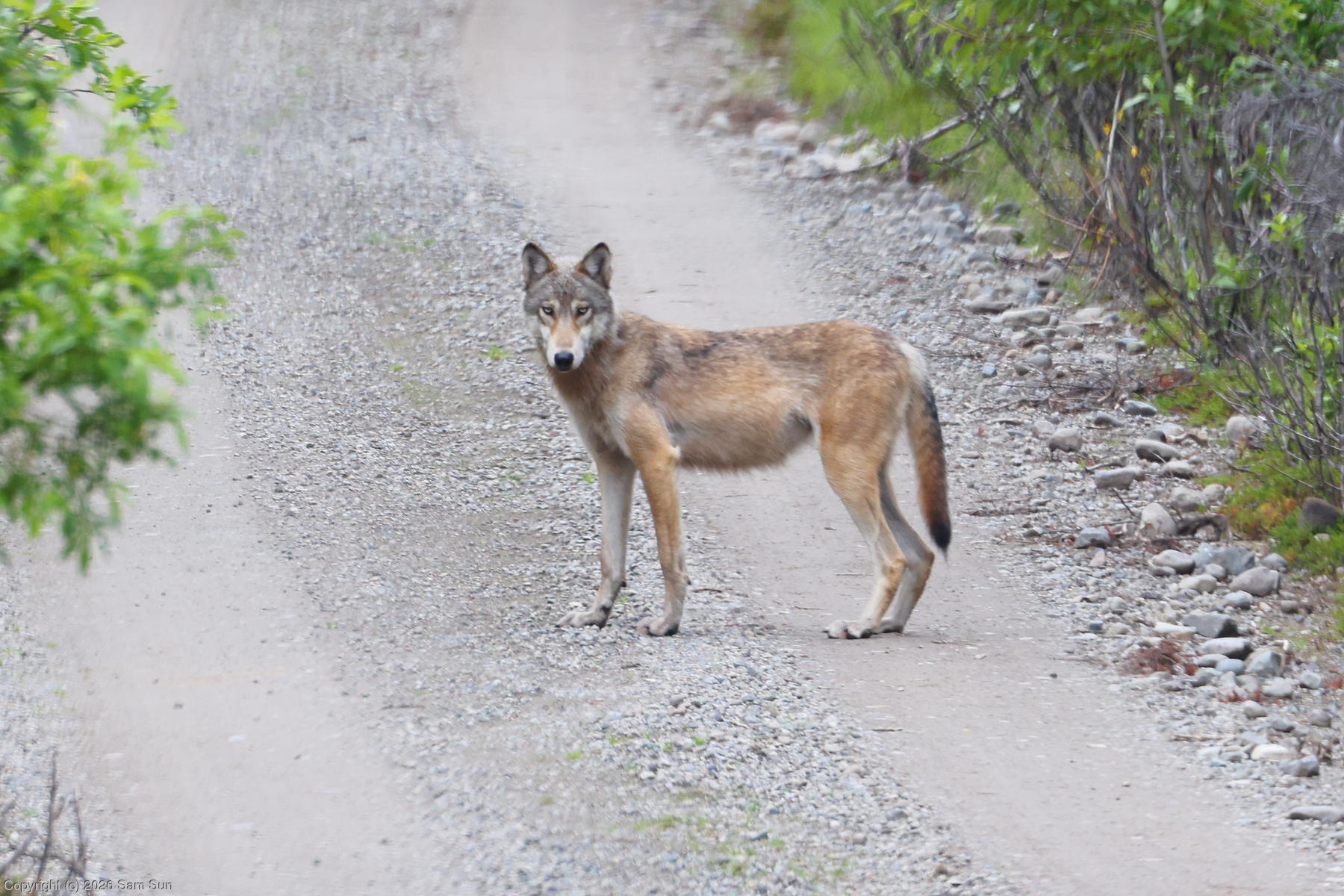
| A wolf! |
 |
| So many salmon! |
 |
| Easy pickings |
 |
Unlike Wildman Lodge, there was no Starlink service at Brooks Lodge. A number of lodge guests and campers had Starlink mini kits with them, which were a bit of a headache for the rangers to police because *nothing* is supposed to be left outside unattended - they tend to become bear toys. In order to get a weather brief for my flight later in the day, I broke out my satphone again to give Flight Service a call. Weather at King Salmon was to be windy, rainy, and IFR all day. Weather in Anchorage was VFR, but forecast to deteriorate later in the day with rain moving in.
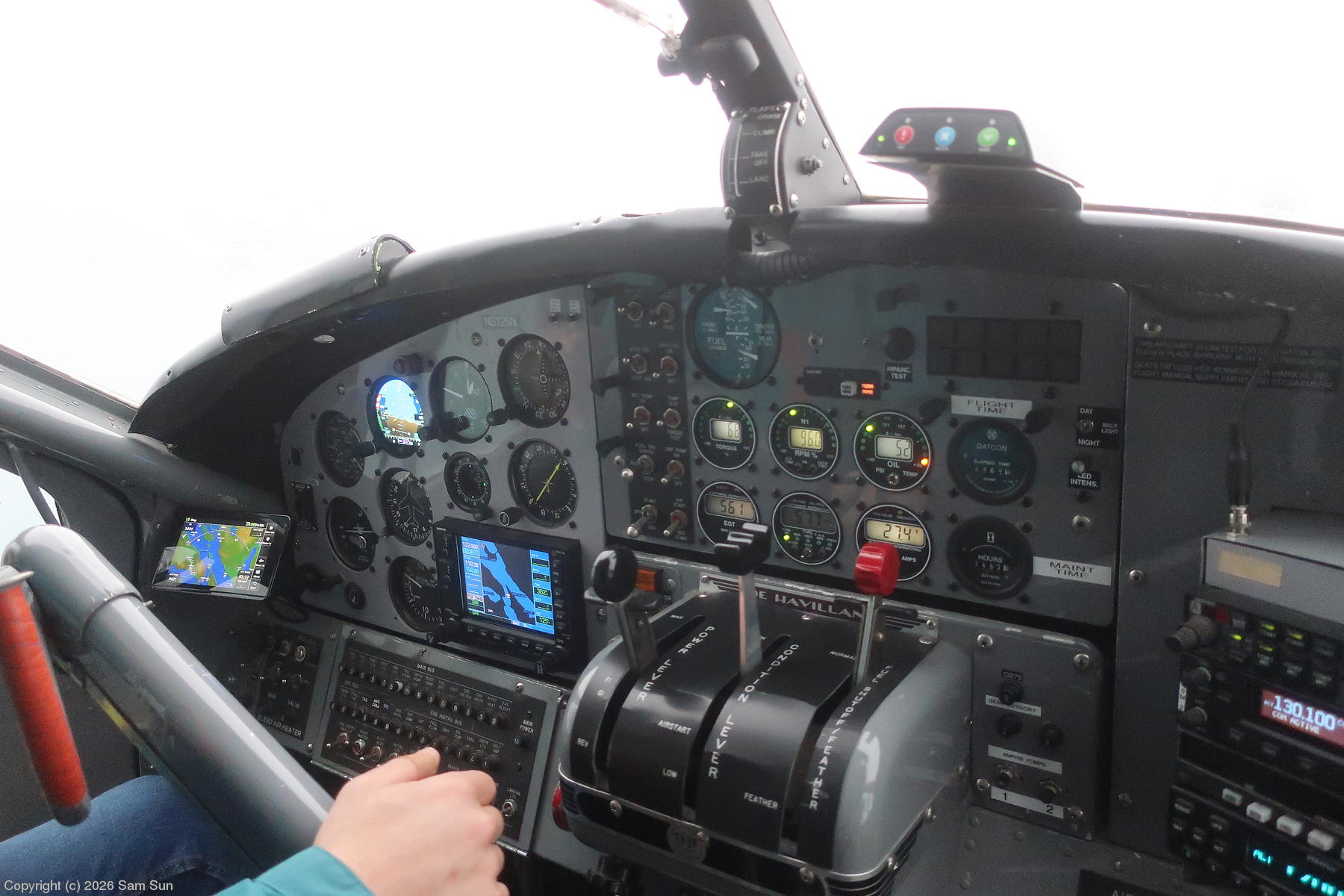
My original plan had been to stay at Brooks in the morning and take an afternoon flight back to King Salmon before proceeding to Anchorage in my own plane. Based on the weather forecast, I opted for the morning flight out of Brooks so I could get to Anchorage in better weather. I scored the copilot seat for the flight, although unlike in the Pilatus, there wasn't an extra headset, so I couldn't chat with the pilot or hear any of the radio communications. With the low ceilings, we flew at 1000', at times slightly lower. Visibility varied from decent to rather murky, and condensation on the windows didn't help. Clearly anticipating the situation, the pilot handed me a towel to help clear things up. The Otter appeared to be equipped for IFR flight, but we got into King Salmon in marginal VFR conditions. It was evident there was a strong gusty crosswind, which the pilot handled smoothly.
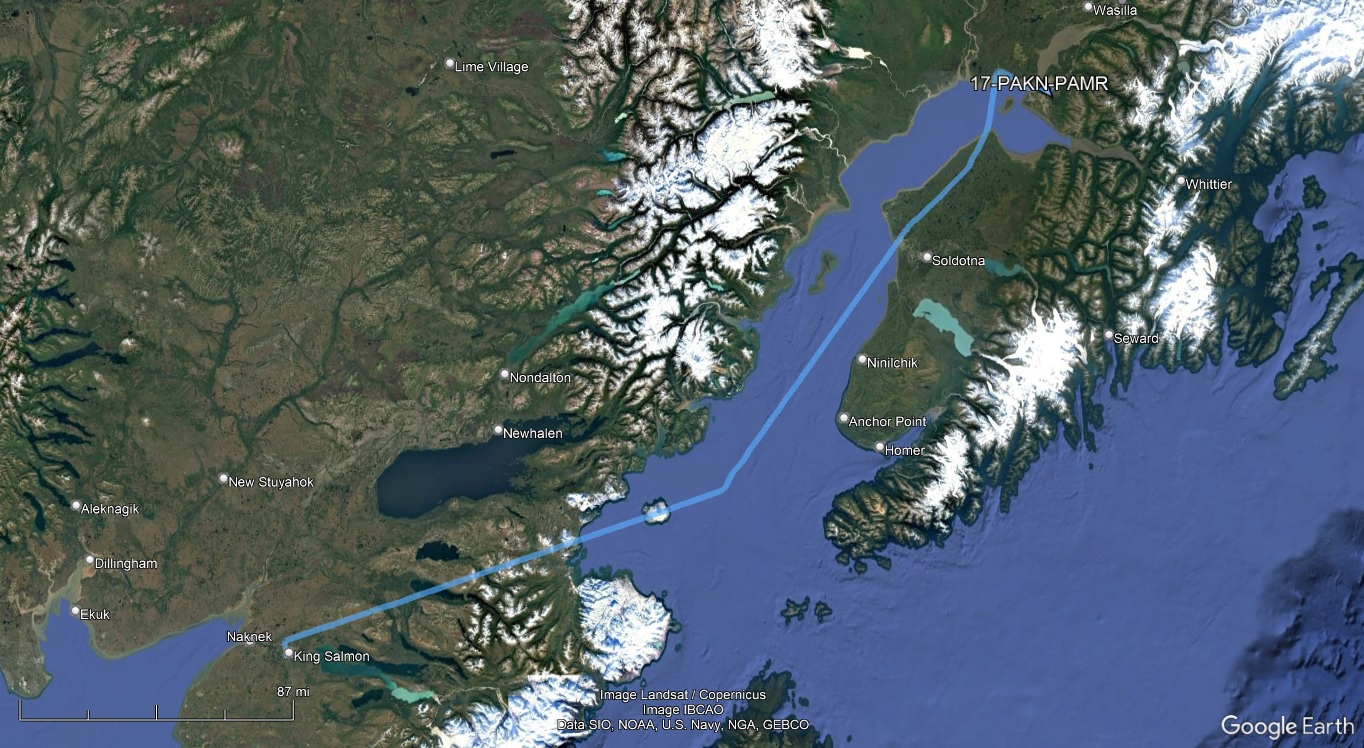
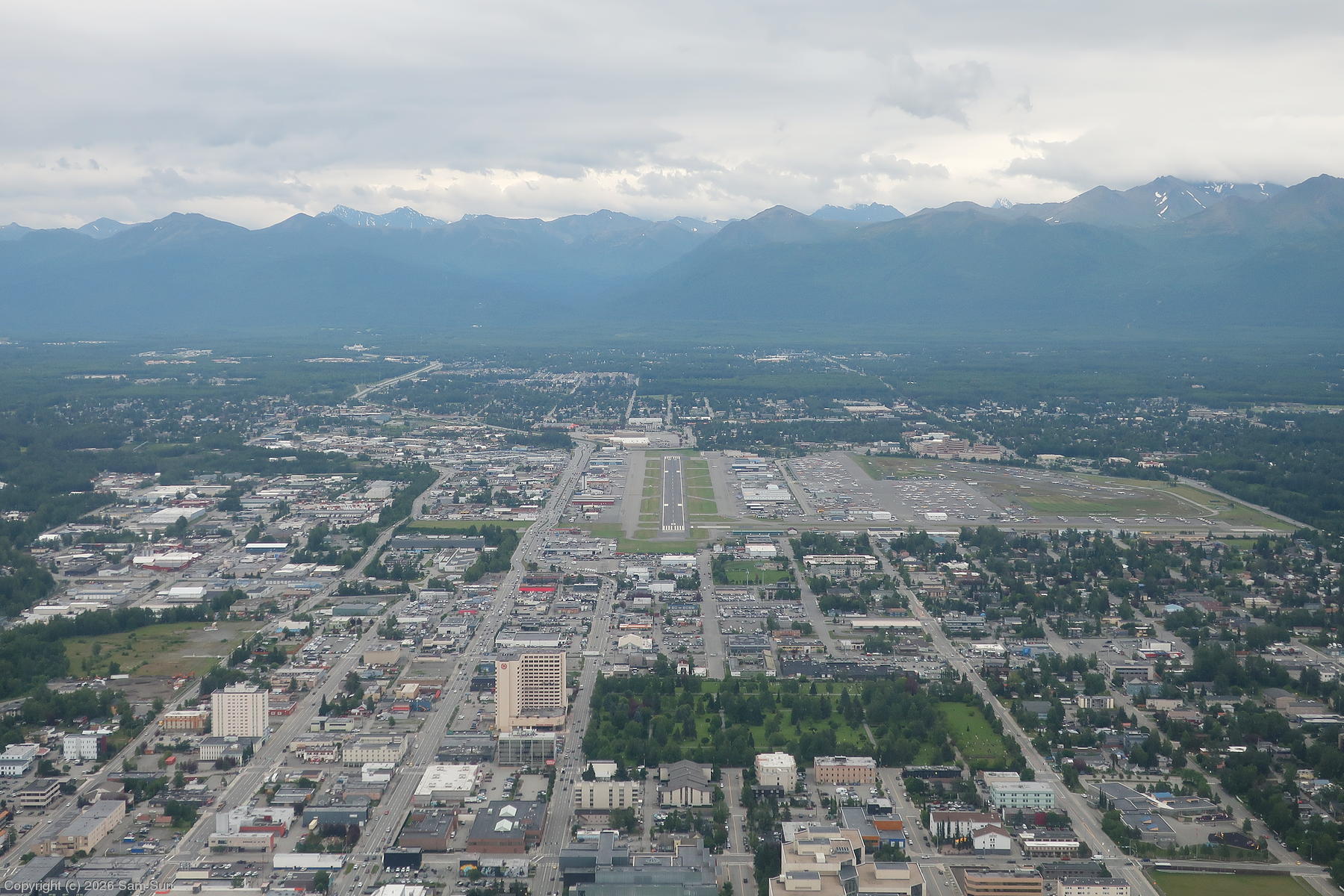
A couple hours later, I departed King Salmon in my own plane IFR and climbed into the clouds. Cleared as filed (PAKN AKN V321 AUGEY V334 ENA V456 TED PAMR), with an altitude assignment of 7000', I did not find the top of the clouds. It was also the freezing level and the base of forecast icing conditions, so I kept a watchful eye on that. Over the Cook Inlet approaching Kenai, I noticed traces of frost/ice forming on the wings again, but before I even reported it, ATC started stepping me down for the approach into Anchorage and I popped out under the clouds. I stayed with the IFR and RNAV-A approach as I figured it was preferable to navigating the congested airspace VFR. There are special Part 93 VFR flight rules and corridors in the vicinity of Anchorage due to the proximity of the international airport, Elmendorf AFB, Lake Hood, and Merrill Field.
I made a stop at Northern Lights Avionics, which had convenient ramp access and an extensive pilot shop, to stock up on oil, which I found to my surprise was cheaper than in California. I also found I had lost a significant amount of paint on the leading edges of the wing during the flight. I'm a bit baffled as to how, given I had encountered more rain and more ice on the earlier Kodiak to King Salmon leg than this one, without any apparent effect on the paint.
| Front office of a turbine Otter |
 |
| Merrill Field, Anchorage |
 |